Introduction
Electronic paper displays, commonly known as e-paper or e-ink displays, have revolutionized the way we consume digital content in low-power environments. It is designed to mimic the appearance of ink on paper; these displays offer a comfortable reading experience while consuming minimal energy. ZCS have extended this technology into a featured tablet, showcasing use case like notepad applications.
This blog explores the key advantages, limitations, and important design considerations when working with e-paper displays, along with insights from our experience building an EPD-based tablet.
What is an E-Paper Display?
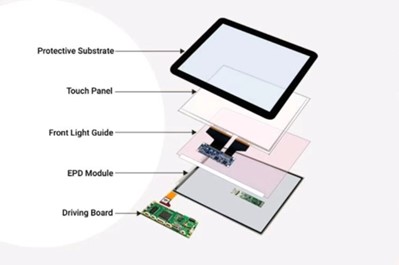
E-paper displays use electrophoretic technology, where tiny microcapsules filled with charged pigment particles move under an electric field to form text and images. Unlike LCD or OLED screens, e-paper reflects ambient light rather than emitting its own, giving it a paper-like appearance.
Design Considerations for E-Paper Displays
Designing with E-INK requires careful coordination between hardware and system-level behavior.
- Power Supply Design
E-INK panels require multiple regulated voltage rails rather than a single supply.
- Use a dedicated PMIC or EPD power IC
- Ensure stable and low-noise supply during refresh cycles
- Power Consumption Strategy
Although E-INK is low power, poor design can waste that advantage.
- Power is primarily consumed during panel refresh
- Implement power gating to display circuitry when idle
- Optimize firmware to minimize unnecessary updates
- Display Controller Selection & interface
E-INK panels require a timing controller (TCON) or EPD controller
- Choose SoC with built-in EPD support when possible
- Use external EPD controllers for MCU without built-in support
- Smaller displays come with SPI interface
- Parallel interfaces are preferred for Large/ high-resolution panels.
- Touch Integration
- Capacitive touch (for general interaction)
- EMR (preffered for stylus based writing tablets)
- Front Light Design
E-INK is not self-emissive, so front lighting is often needed.
- Refresh Rate & Update Strategy
E-INK displays are slow compared to traditional screens.
- Avoid rapid updates like animations, scrolling lists, or video
- Use partial refresh for localized updates to improve responsiveness
- Schedule periodic full refresh cycles to eliminate ghosting artifacts
- Screen Size and Resolution
- For tablet designs, selecting the right balance between screen size, resolution, and refresh performance is crucial.
ZCS Experience: Building an EPD-Based Tablet
As part of our product innovation journey, we developed a tablet powered by an EPD (Electronic Paper Display). This project highlighted both the strengths and practical engineering challenges of using e-paper in a more interactive, portable computing form factor.
Key Highlights
- Extended Battery Performance: Achieved long operational time due to minimal refresh-based power consumption
- Comfortable User Experience: Paper-like display significantly reduces eye strain
- Excellent Outdoor Visibility: Superior readability under direct sunlight compared to conventional displays
Engineering Challenges Encountered
- VCOM voltage tuning
- Strict Power sequencing requirements
- Clock and timing configuration sensitivity
- Ghosting effect during partial update
Common Applications
- E-readers
- Electronic shelf labels
- Smart ID cards
- IoT dashboards
- Wearable devices
- E-paper tablets (reading, note-taking)
Advantages of E-Paper Display based products
- Ultra-Low Power Consumption
- Excellent Readability
- Paper-Like Experience
- Long Battery Life
Limitations of E-Paper Displays
- Slow Refresh Rates
- Limited Color Support
- Ghosting Effects
- Higher Cost compared to conventional displays
Conclusion
E-paper displays are a compelling choice for applications where power efficiency, readability, and user comfort are prioritized over speed and color richness. However, achieving an optimal design requires careful attention to power architecture, waveform control, and system-level optimization.
Our experience at ZCS demonstrates that, with the right design approach, EPD technology can successfully power next-generation low-power computing devices such as digital writing tablets.