The IoT ecosystem has grown rapidly, but with growth came fragmentation — different protocols, incompatible devices, and heavy reliance on vendor-specific apps and clouds. Matter was introduced to solve this exact problem.
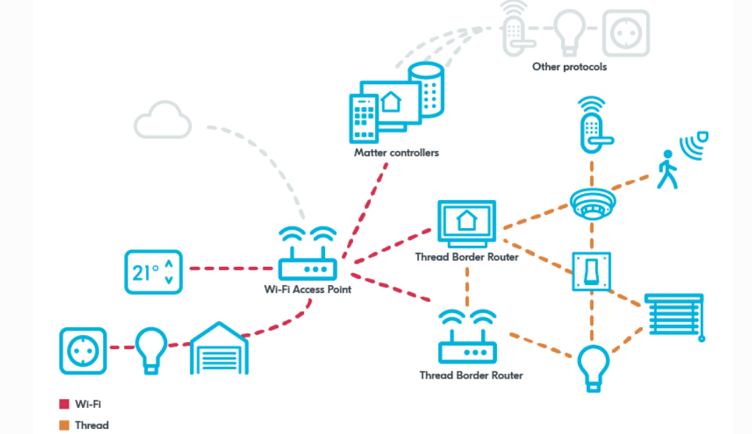
Matter is a unified, open-source connectivity standard developed by the Connectivity Standards Alliance (CSA). It simplifies and standardizes device communication across different ecosystems (e.g., Apple HomeKit, Google Home, Amazon Alexa). A Matter network can be made of one or more IPv6-based networks, for example Wi-Fi network or Thread network.
Matter allows for connecting with external networks based on other protocols, such as Zigbee, through Matter bridges. All Matter devices that use Thread technology must also have Bluetooth LE enabled at the same time to allow new devices to join the network. Wi-Fi can be used for high bandwidth applications.
At a high level, Matter provides:
- A common language for smart devices
- Secure onboarding and communication by default
- Local-first operation with optional cloud connectivity
- Freedom from vendor lock-in across ecosystems
Voice Controlled Matter Hub
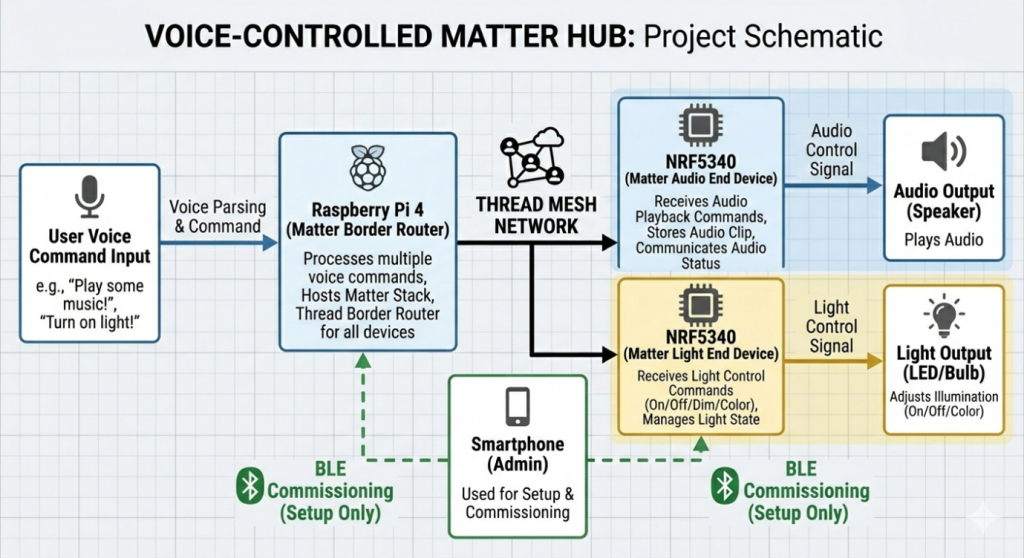
To explore Matter practically, Z-Crossing team had implemented a simple matter set-up using nRF5340 as a Matter end devices and a Raspberry Pi 4 running a Linux-based Thread Border Router.
Key components:
Border router: This element forwards the messages from the matter controller to the matter devices. Open Thread Border Router (OTBR) on Raspberry Pi was used. Examples of commonly used routers are Amazon Echo series, Google Nest series etc.
Matter controller: It Is the device which collects the Instructions and sends It to the different matter devices. In a connected home, it could be a Voice Assistant, like Alexa. We have used ZCS – Voice – to-text application for this project.
Matter End devices: The device which Is receiving the matter commands and executes a physical action. We have used custom end-devices using NRF5340 for audio and light controls.
In this project:
- The nRF5340 runs the Matter device stack over Thread
- Raspberry Pi 4 acts as the Matter controller and border router
- Audio control commands are sent from the Pi to the nRF5340 over Thread
- The MCU processes these commands and controls audio or light behaviour locally
This setup clearly demonstrated how Matter enables secure, low-latency, IP-based communication between Linux gateways and MCU-based devices — without custom protocols or vendor-specific glue logic.
Matter is not just a smart-home standard; it’s a well-thought-out IoT architecture that fits naturally into real embedded systems combining end devices and gateways.
Have a groundbreaking product idea leveraging the Matter protocol? At Z-Crossing Solutions, we specialize in transforming ambitious concepts into market-ready solutions. From Automotive Embedded Systems and IoT to Industrial Automation and Agri-Tech, our engineering team provides the end-to-end expertise needed to build the future of connected technology. Let’s collaborate to turn your vision into a reality.